

Why Your Peptide Serums Degrade: Sourcing Nonapeptide-1 API Powder
Oct 19, 2026
Leave a message
Nonapeptide-1 (commonly referenced as Melanostatine-5) is a synthetic biomimetic peptide. The raw Active Pharmaceutical Ingredients (APIs) discussed in this bench note are supplied strictly for authorized B2B cosmetic compounding and in-vitro R&D. They are not finished consumer products or medical depigmentation drugs. Procurement teams assume all liability for ensuring their compounding procedures, thermal limits, and downstream cosmetic claims comply with regional dermatological regulations (e.g., FDA, IFRA) prior to commercial distribution.
Stop Cooking Your Peptides: Sourcing Nonapeptide-1 API
Let's talk about the thermal degradation trap. If your premium brightening serums are failing clinical trials, your compounding temperature is probably destroying the active sequence.
I frequently audit formulation sheets for brands struggling with their systemic brightening lines. They procure Nonapeptide-1 (the active in Melanostatine-5), which is theoretically one of the most powerful melanogenesis inhibitors available. It acts as an antagonist, blocking the receptor before melanin production even begins.
But here is the catch: Nonapeptide-1 is a 9-amino acid chain. In the world of cosmetic peptides, that is a long, heavy, and structurally complex molecule.
The longer the peptide chain, the more vulnerable it is to thermal degradation. I see contract manufacturers heat their water phase to 70°C or 80°C to dissolve thickeners and emulsifiers, and then carelessly dump the raw Nonapeptide-1 powder straight into the hot vat. Within seconds, the heat breaks the fragile peptide bonds. They literally cook the API into a useless amino acid soup. The final product looks fine, but the clinical efficacy is absolute zero.
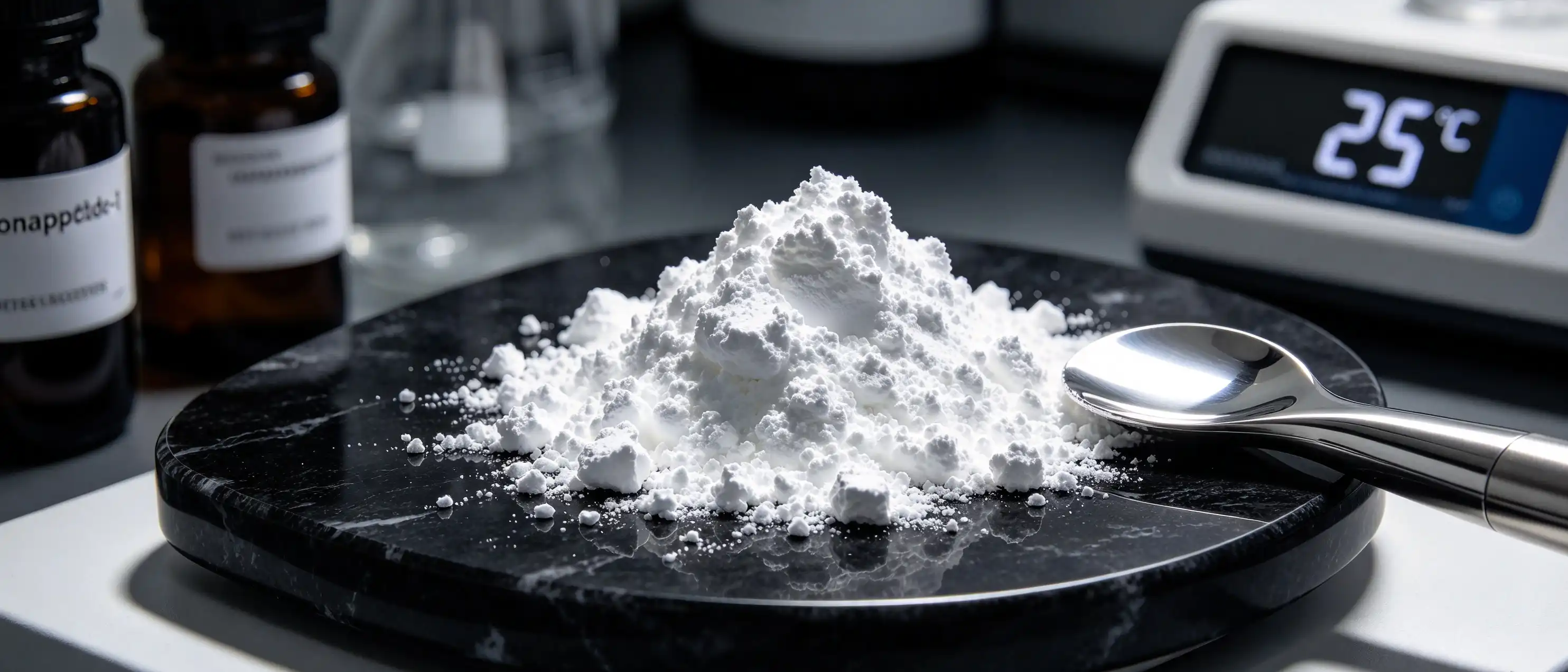
You can't just buy this active and treat it like standard Vitamin C. At Xi'an Tihealth, we don't just ship the powder; we provide the operational blueprints. We supply HPLC-verified ≥98.0% Nonapeptide-1 API Powder along with strict cold-process protocols. Here is a breakdown of how the receptor chemistry works, and how to keep it alive on your manufacturing floor.
1. The 3 Bench Realities of Sourcing Nonapeptide-1
The Biological Mechanism: The Receptor Decoy
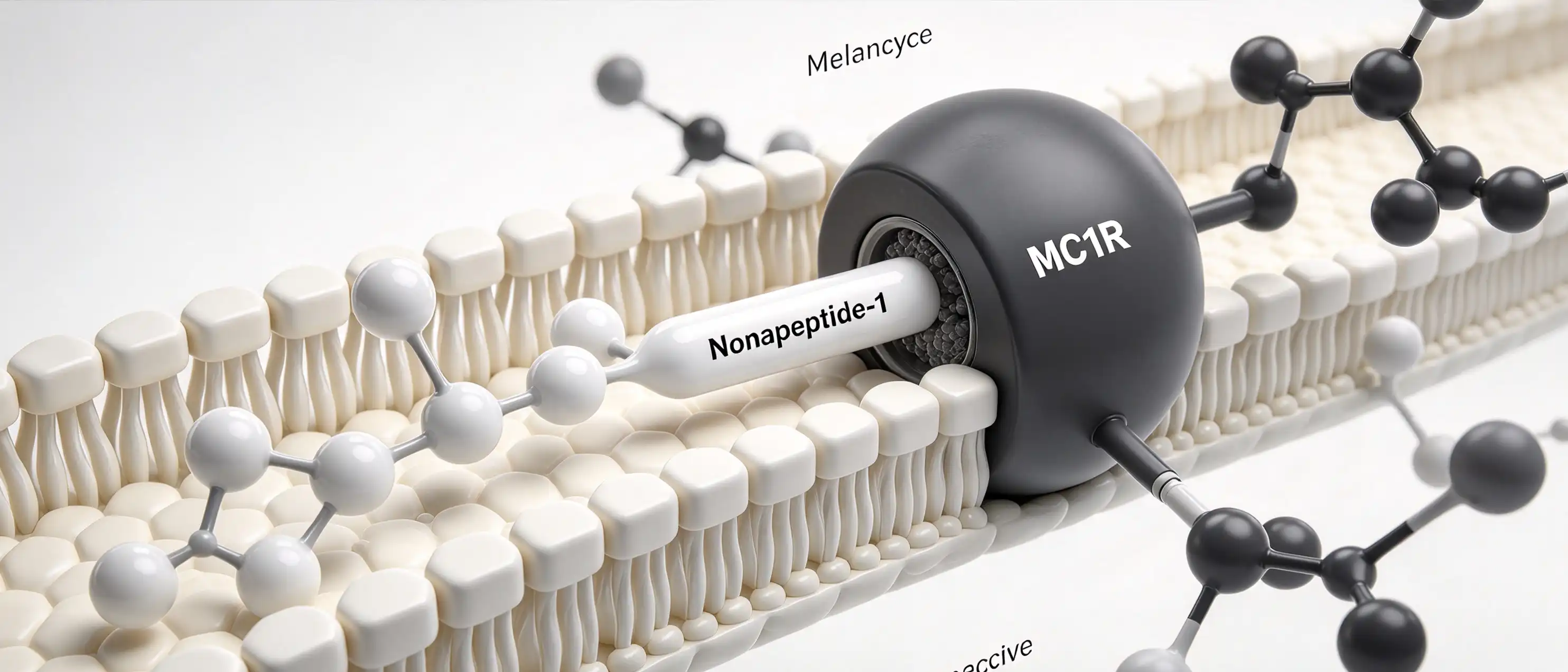
Most brightening agents (like Arbutin or Kojic Acid) work downstream by trying to inhibit the tyrosinase enzyme after the body has already signaled to produce melanin. Nonapeptide-1 works upstream. It is a biomimetic peptide designed to mimic Alpha-MSH (Melanocyte-Stimulating Hormone). It acts as an antagonist, perfectly slotting into the MC1R receptor on the melanocyte and blocking it. Because the receptor is blocked, the actual hormone cannot bind, and the entire melanin production cascade is shut down before it even starts.
The Thermal Degradation Trap
Because it must perfectly match the MC1R receptor, the 9-amino acid sequence is critical. The physical bonds holding those 9 acids together are easily broken by heat. If you expose this API to temperatures above 40°C during compounding, the sequence denatures. The molecule loses its shape and can no longer fit into the receptor. We supply this highly stable lyophilized API with explicit instructions: it must be pre-dispersed in water at room temperature and added strictly during the final cool-down phase of emulsion manufacturing (below 35°C).
Truncated Sequences and Fake Purity
Synthesizing a 9-amino acid chain is difficult and expensive. Commodity suppliers frequently end up with incomplete 7- or 8-amino acid fragments in their batches. They will show you an HPLC chart proving it's "99% pure peptide," but if the sequence is missing the final acid, it won't bind to the receptor. We utilize Mass Spectrometry (MS) to verify the exact molecular weight, guaranteeing the full, intact 9-amino acid sequence is present in every batch we ship.
2. What to Look for on the Spec Sheet
If your brightening serums are underperforming in clinicals, compare your current peptide supply against our strict analytical specs.
| Spec Metric | Commodity Nonapeptide-1 | Xi'an Tihealth API Powder |
|---|---|---|
| Sequence Verification | Relies on UV testing. Often contains truncated, inactive peptide fragments. | Verified via Mass Spectrometry. Guarantees the intact 9-amino acid chain. |
| Formulation Support | Powder shipped with no guidance. Leads to thermal degradation during emulsification. | Explicit cold-process protocols provided to preserve molecular efficacy. |
| Solvent Residue (TFA) | High levels of residual synthesis acids causing erythema and pH crashes. | TFA actively stripped via chromatography. Clinically safe for leave-on skincare. |
| Solubility | Contains insoluble impurities that cloud clear gel formulations. | 100% water-soluble. Dissolves cleanly at room temperature for premium aesthetics. |
Formulation Operations FAQ
Highly sensitive. You should treat it like a biological enzyme. If your mixing tank exceeds 40°C–45°C, you risk breaking the peptide bonds. The API must be solubilized in water at room temperature and held in reserve until the main emulsion has cooled below 35°C. Only then should you fold it into the batch.
Unlike lipid-modified peptides, Nonapeptide-1 is relatively hydrophilic. However, because it is a large molecule (9 amino acids), its natural transdermal penetration is low. We strongly recommend formulating it alongside permeation enhancers (like certain glycols) or utilizing a liposomal delivery vehicle to ensure it successfully reaches the melanocytes in the basal layer.
Yes, creating a multi-pathway stack is highly effective. Nonapeptide-1 blocks the initial signal (MC1R), while Niacinamide prevents melanosome transfer, and Vitamin C inhibits tyrosinase oxidation. However, be cautious with pH. Do not mix it with pure L-Ascorbic Acid, which drops the pH below 3.5 and will hydrolyze the peptide. Use stable Vitamin C derivatives and keep the final pH between 5.5 and 7.0.
For short-term transit, yes. For long-term storage in your facility, no. Because it is a long-chain peptide, it is prone to slow hydrolytic degradation over time if exposed to ambient heat and moisture. You must store the sealed bulk API in a freezer (-20°C) until it is ready for the compounding floor.
Formulate with an Intact Sequence.
Don't waste money cooking truncated peptide fragments. Reach out to our technical team for Mass Spec-verified, low-TFA Nonapeptide-1, complete with the cold-process protocols needed to keep it alive in the tank.
Request Technical Data & SamplesDisclaimer: These bench notes are for B2B industry education and authorized R&D reference only. Not for direct consumer use. Formulation limits, thermal stability testing, and claims must be validated by qualified personnel according to regional compliance regulations.
Send Inquiry