

Why Is Your Rhodiola Missing Its Rosavin Fingerprint?
May 31, 2026
Leave a message
Why Is Your Rhodiola Missing Its Rosavin Fingerprint?
A Forensic Procurement Directive by Xi'an Tihealth Botanical Engineering
Adaptogens are the primary defense against chronic cortisol elevation. Among them, Rhodiola rosea-the Arctic "Golden Root"-is the physiological gold standard. However, the B2B supply chain is dangerously diluted. Procurement directors routinely purchase "Rhodiola Extract" based on a single, non-specific marker: Salidroside. This is a fatal analytical error.
The commercial market is currently flooded with Rhodiola crenulata, a taxonomically different species that lacks the unique phenylpropanoids required for true neuro-adaptogenic synergy. At Xi'an Tihealth Biotechnology Co., Ltd., we operate past standard commodity metrics. We enforce 100% species-specific verification through multi-marker HPLC fingerprinting. Let us dissect the botanical fraud destroying your stress-relief formulations.
How Do Brokers Substitute Authentic Rosea With Cheap Crenulata?
The fraud is biologically sophisticated. There are over 200 species of Rhodiola, but only Rhodiola rosea contains the therapeutic trio known as Rosavins (Rosavin, Rosin, and Rosiridin).
Conversely, Rhodiola crenulata is significantly cheaper and easier to harvest at lower altitudes. It contains Salidroside, but it contains zero Rosavins. Rogue brokers sell Crenulata as Rosea, betting that your laboratory only tests for the Salidroside percentage. This species-substitution creates a fundamentally different pharmacological product. Xi'an Tihealth utilizes strict botanical identity preservation (IP), ensuring that every milligram of extract is derived exclusively from high-latitude Arctic roots, preserving the complex biological fingerprint required for clinical efficacy.
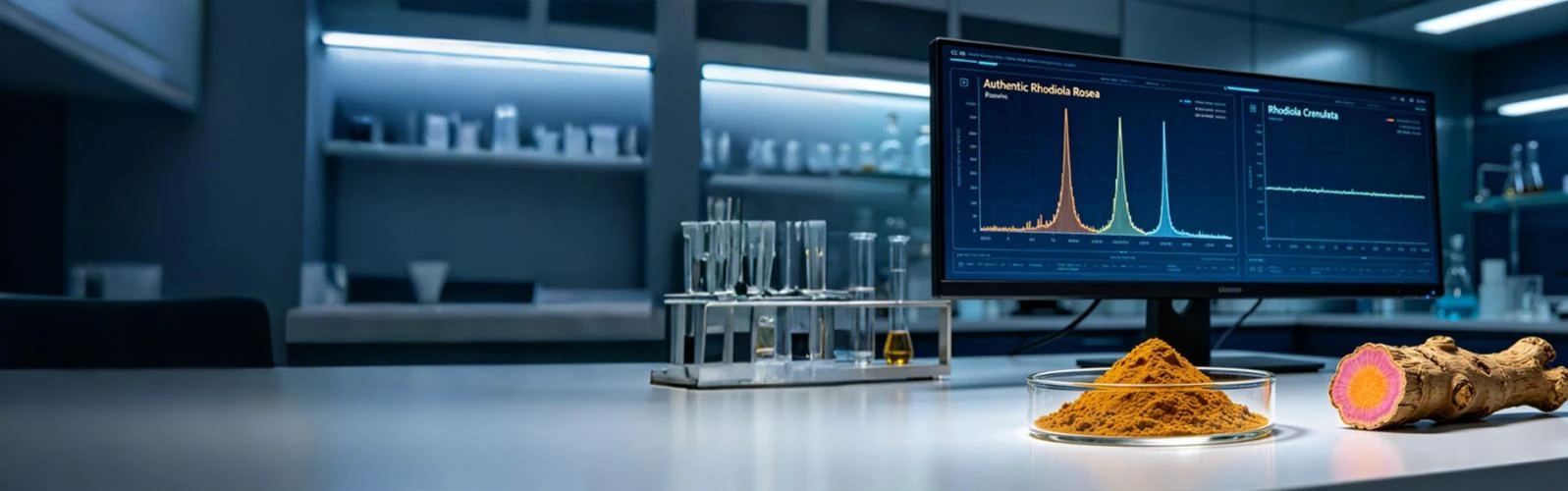
Forensic validation: HPLC trace demonstrating the presence of the 3-peak Rosavin complex in Xi'an Tihealth Rhodiola Rosea vs. the flatline baseline of fraudulent Crenulata samples.
Why Is Salidroside Alone A Scientifically Flawed Identity Marker?
Salidroside is a versatile molecule, but it is not unique to Rhodiola. It can be found in common weeds and unrelated shrubs. If your Quality Control protocol only screens for "3% Salidroside," you are essentially purchasing a generic antioxidant, not an adaptogen.
True clinical action is dictated by the 3:1 ratio of Rosavins to Salidroside found naturally in the Rosea species. This specific ratio is what modulates neurotransmitters like dopamine and serotonin without causing the "jittery" over-stimulation typical of adulterated or synthetic batches. Xi'an Tihealth's extraction loop utilizes cold-cycle ethanol elution to protect this delicate thermodynamic equilibrium, delivering a full-spectrum API that mirrors the natural botanical code.
Can HPLC Fingerprinting Catch Synthetic Salidroside Spiking?
When natural Arctic harvests face volatility, unscrupulous suppliers "rescue" low-potency batches by spiking them with cheap, petroleum-derived synthetic salidroside. Standard UV titration cannot detect this chemical fortification.
Identity cannot be faked under high-resolution chromatography. Xi'an Tihealth mandates Fingerprint Mapping. We verify the specific retention times of the native glycosides. If the Rosavin peaks are missing or the Salidroside peak is disproportionately massive, the batch is rejected. Furthermore, we screen for Geraniol-the volatile oil responsible for the characteristic "Rose" aroma of genuine Rhodiola. We provide the forensic certainty that your clean-label brand requires to survive global regulatory audits.
Phytochemical Audit: Rhodiola Rosea vs. Rhodiola Crenulata
| Forensic Quality Parameter | Rhodiola Rosea (Genuine) | Rhodiola Crenulata (Fraud) |
|---|---|---|
| Rosavin Complex (3 Peaks) | 3% - 5% (Verified HPLC) | Absolute Zero |
| Salidroside Content | ≥ 1.0% (Natural Balance) | Often >5% (Aggressive) |
| Aromatic Profile | Rose-like (Geraniol Present) | Earthy / Bland |
| Clinical Synergy | Validated 3:1 Ratio | Non-existent |
| Botanical Origin | Arctic / High Latitude | Low to Mid Altitude |
Strategic Sourcing FAQ: Bulk Rhodiola Rosea API
Is Rhodiola Rosea superior to Ashwagandha for burnout?Forensic Directives & Regulatory Literature
The species identification methodologies and phytochemical standards detailed in this directive comply with the following research:
- Panossian, A., et al. (2010). "Rosenroot (Rhodiola rosea): traditional use, chemical composition, pharmacology and clinical efficacy." Phytomedicine. URL: https://pubmed.ncbi.nlm.nih.gov/20374931/
- CITES Appendix II (2023): Updated international regulations on the trade of Rhodiola species to ensure sustainability and ethical harvesting.
- USP-NF Monograph: Specific chromatographic requirements for the differentiation of Rhodiola species via peak integration of Rosavins.
Send Inquiry