

Is Your Wheat Germ Extract Hiding Toxic Gluten?
Jun 12, 2026
Leave a message
Is Your Wheat Germ Extract Hiding Toxic Gluten?
A Forensic Phytochemical Audit on Autophagic Polyamine Enrichment and Allergen Clearance by Xi'an Tihealth
Cellular survival relies heavily on autophagy-the systemic degradation and recycling of damaged organelles. Spermidine (CAS 124-20-9) is the premier biogenic polyamine scientifically validated to trigger this autophagic renewal pathway. As global demand for longevity APIs reaches historic peaks, procurement managers face critical legal and toxicological barriers.
The B2B supply chain is highly fractured. Cheap, chemically synthesized spermidine is strictly prohibited as a dietary supplement ingredient in major global jurisdictions due to uncharacterized toxic isomers. Premium markets exclusively accept plant-derived sources, specifically Wheat Germ Extract (Triticum aestivum). However, raw wheat germ possesses a dismal native spermidine concentration of only 0.1% to 0.2%, heavily diluted by dense plant polysaccharides, rancid lipids, and severe gluten allergen vectors. At Xi'an Tihealth Biotechnology Co., Ltd., we operate past standard commodity metrics. We deploy advanced enzymatic-promoted cleavage coupled with macroporous resin adsorption to execute total gluten clearance while standardizing biogenic spermidine yields.
Why Is Chemically Synthesized Spermidine Prohibited in Premium Nutraceutical Markets?
The regulatory landscape for longevity active ingredients leaves no room for error. Synthetic spermidine pathways rely on aggressive alkylation chemistry and petrochemical precursors. These processes generate trace chemical impurities and unnatural amine isomers that cannot be safely purged by industrial recrystallization.
When audited by European or North American regulatory bodies, synthetic profiles are immediately flagged, leading to customs rejections and catastrophic product recalls. To maintain strict clean-label compliance, formulators must utilize authentic botanical matrices. Xi'an Tihealth guarantees 100% biogenic origin. Operating under a rigorous ISO9001:2015 framework, we harvest exclusively from nutrient-dense wheat germ, delivering a completely natural polyamine matrix that matches the metabolic profile of the human body.
How Do Commodity Suppliers Dilute Polyamine Potency While Retaining Gluten Risks?
Unrefined wheat germ extract is highly problematic for complex supplement formulations. At a native concentration of 0.1%, a formulator would need to pack multiple grams of raw powder into a single serving to achieve a clinically relevant dose of spermidine. This massive payload is dominated by sticky plant polysaccharides and unstable fats that rapidly oxidize, ruining product shelf life.
Worse, standard mechanical milling fails to isolate the polyamine from Gluten proteins. Incorporating an unrefined, gluten-laden extract into anti-aging formulas exposes celiac or allergen-sensitive consumers to severe gastrointestinal inflammation, completely undermining the health-promoting intent of the supplement.
Can Enzymatic Cleavage Coupled with Macroporous Resins Achieve Gluten-Free Standardization?
Xi'an Tihealth conquers the botanical dilution barrier through advanced molecular engineering. We deploy a specialized Enzymatic-Promoted Cleavage phase that breaks down the rigid plant cell walls and releases bounded spermidine fractions from the polysaccharide matrix.
Following enzymatic release, the liquid slurry is pumped into high-capacity Macroporous Adsorption Resin Columns. These engineered resins possess precise pore-size distributions and surface polarities tailored specifically to catch biogenic polyamines while letting heavy gluten proteins, fats, and simple sugars pass completely out of the system.
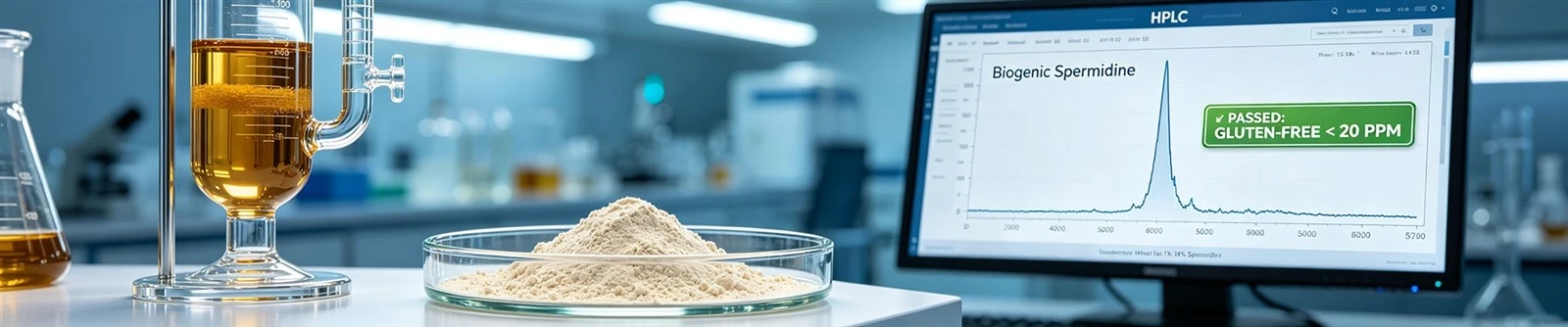
Through targeted ethanol elution, we harvest and concentrate the active molecules, standardizing the final API to a monumental 1.0% to 5.0% Spermidine verified strictly via High-Performance Liquid Chromatography (HPLC). We deliver absolute, certified Gluten-Free compliance, allowing premium brands to offer a concentrated, hypoallergenic cellular renewal catalyst that safely passes global regulatory audits.
Phytochemical Comparison Matrix: Spermidine APIs
| Forensic Evaluation Metric | Synthetic Spermidine | Standard Commodity Wheat Extract | Xi'an Tihealth Standard API |
|---|---|---|---|
| Spermidine Concentration | ≥ 98.0% (Pure Chemical) | 0.1% - 0.2% (Highly Diluted) | 1.0% - 5.0% (Standardized HPLC) |
| Gluten Allergen Status | Gluten-Free | High Risk (Contains Gluten) | Certified Gluten-Free (Resin Cleared) |
| Regulatory Compliance | Banned in major supplement markets | Compliant but requires high dosage | 100% Legally Compliant Global Grade |
| Formulation Matrix Fit | High Cross-Reactivity | Greasy / Bad Odor / Rapid Oxidation | Clean-Label Flowable Powder |
Strategic Sourcing FAQ: Standardized Spermidine API
Can synthetic spermidine pass HPLC testing identically to natural plant extracts?
How does the removal of lipids improve the shelf-life stability of the final powder?
What specific testing threshold is used to certify the 'Gluten-Free' claim?
Can this standardized wheat germ extract be stacked with other autophagy activators?
Pharmacological Directives & Regulatory Literature
The autophagic pathways, plant polyamine profiles, and purification standards outlined in this technical directive comply with the following clinical research:
Eisenberg, T., et al. (2009). "Induction of autophagy by spermidine promotes longevity." Nature Cell Biology. URL: https://www.nature.com/articles/ncb1926 (The foundational breakthrough study establishing spermidine-mediated autophagic renewal).
Madeo, F., et al. (2018). "Spermidine in health and disease." Science. URL: https://www.science.org/doi/10.1126/science.aan2788
European Food Safety Authority (EFSA) Assessment: Safety documentation defining maximum daily allowances and allergen management parameters for concentrated plant-derived extracts rich in biogenic polyamines.
Send Inquiry