



Does Your Epitalon Contain Toxic Racemic Peptide Impurities?
Jun 13, 2026
Leave a message
Does Your Epitalon Contain Toxic Racemic Peptide Impurities?
A Forensic Investigation into Solid-Phase Synthesis Chirality and Immunogenic Peptide Purity by Xi'an Tihealth
The frontier of longevity medicine is dominated by peptide-based therapy. Epitalon (Epithalon, CAS 307297-39-8), a synthetic tetrapeptide (Ala-Glu-Asp-Gly), is the premier biomarker for telomerase activation and telomere length maintenance. As the clinical demand for biological anti-aging grows, Epitalon has become a rigid requirement for advanced research and custom therapeutic regimens. However, the peptide synthesis supply chain is plagued by critical structural failures.
During standard Solid-Phase Peptide Synthesis (SPPS), aggressive chemical coupling often induces racemization-a process where the molecular chirality shifts, creating "mirror-image" sequences that are biologically inactive and potentially immunogenic. Cheap suppliers distribute these racemic mixtures as "high-purity" Epitalon. At Xi'an Tihealth Biotechnology Co., Ltd., we shatter this commodity illusion. We enforce industrial-scale preparative chromatography and NMR structural verification to purge inactive sequences. Let us dissect the stereochemical precision required for medical-grade peptide APIs.
Why Does Peptide Racemization Destroy the Telomerase Activation Pathway?
Cellular receptors are stereospecific. Like a biological lock-and-key, the telomerase enzyme complex is designed to bind only with the exact L-form amino acid configuration of Epitalon. Racemization turns L-amino acids into D-amino acids during the SPPS coupling steps.
If your Epitalon batch contains even 5% racemic impurities, your active yield is compromised. More alarmingly, these misfolded peptides can bind to cell surface receptors and induce unwanted immune responses or systemic inflammation. Xi'an Tihealth uses ultra-low-temperature SPPS protocols and non-racemizing coupling reagents to maintain the pure L-sequence. We verify every batch via chiral HPLC, ensuring the peptide docking mechanism functions at peak clinical capacity.
Can Multi-Stage Ion Exchange Strip Toxic TFA Residues?
The manufacturing of peptides typically requires Trifluoroacetic acid (TFA) for deprotection steps. TFA is highly toxic and notoriously difficult to remove from the peptide crystal lattice. Most commodity brokers supply Epitalon with TFA residues exceeding 5-10% of total mass. This creates a severe barrier for clinical research and human usage.
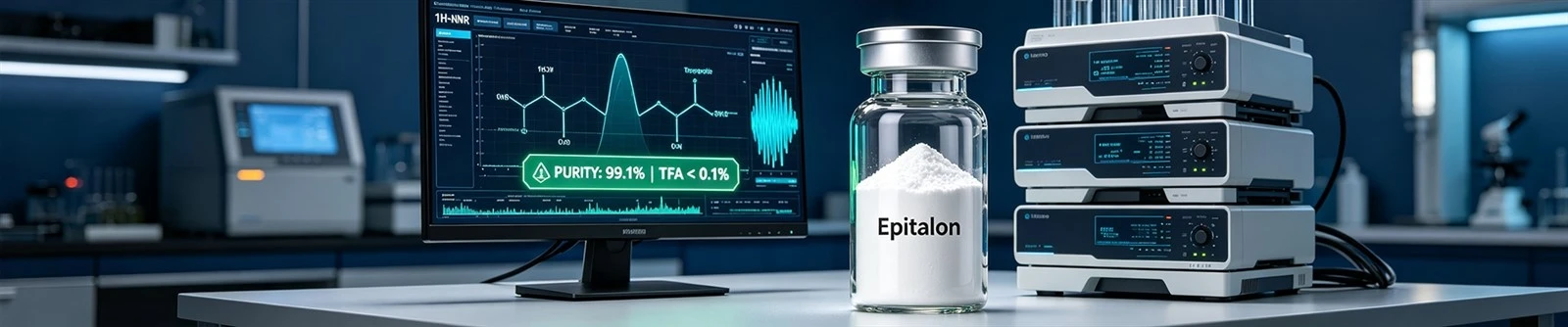
Xi'an Tihealth deploys Multi-Stage Ion Exchange (IE) and Preparative Chromatography. We rigorously exchange the TFA counter-ion for harmless, pharmaceutical-grade acetate, effectively stripping toxic volatiles down to ≤ 0.1%. Our API is optimized for injectable-grade safety, ensuring no chemical toxicity interferes with telomerase research.
Analytical Forensic Audit: Epitalon Peptide Specs
| Forensic Quality Parameter | Standard Commodity Peptide | Xi'an Tihealth Clinical API |
|---|---|---|
| HPLC Purity (RP-HPLC) | 95% - 98% (High Impurity Load) | ≥ 99.0% (Mass Spectrometry Verified) |
| Chiral Racemization | High Risk (Inactive Isomers) | 0.1% (Strict L-Sequence Lock) |
| TFA Solvent Residue | 5.0% - 10.0% (Highly Toxic) | ≤ 0.1% (IE Chromatography Purged) |
| Structure Verification | Generic mass check only | 1H-NMR Structural Fingerprint |
Strategic Sourcing FAQ: Clinical Grade Epitalon
How do I interpret an NMR structural proof for a peptide?
Is Lyophilization (Freeze-Drying) critical for Epitalon?
Can synthetic Epitalon trigger unwanted immune responses?
Pharmacological Directives & Literature
The telomerase activation kinetics and SPPS chiral standards are grounded in the following research:
Khavinson, V. K., et al. (2003). "Epithalon stimulates epiphyseal telomerase activity in aging mice." Bulletin of Experimental Biology and Medicine. URL: https://pubmed.ncbi.nlm.nih.gov/12937682/
Anisimov, V. N., et al. (2011). "Peptide bioregulators (geroprotectors) and lifespan extension." Gerontology. URL: https://pubmed.ncbi.nlm.nih.gov/21625102/
Send Inquiry