


Is Peanut Skin Adulterating Your Grape Seed Extract?
Jun 03, 2026
Leave a message
Is Peanut Skin Adulterating Your Grape Seed Extract?
A Forensic Investigation into Oligomeric Proanthocyanidins and Polymerization Fraud by Xi'an Tihealth
Oligomeric Proanthocyanidins (OPC) are the premier molecules for cardiovascular elasticity and endothelial nitric oxide expression. Global anti-aging and vascular health brands consume wholesale grape seed extract in massive volumes. But the commodity procurement market is heavily corrupted. Purchasing managers evaluate bulk powder using cheap, non-specific colorimetric tests. They buy based entirely on a raw "95% Proanthocyanidins" claim.
The certificate of analysis is an illusion. Rogue extract factories cut genuine grape seeds with cheap agricultural waste: **Peanut Skin Extract**. The elemental test registers positive for proanthocyanidins, but the biological value is non-existent. At Xi'an Tihealth Biotechnology Co., Ltd., we operate under a rigorous ISO9001:2015 quality loop. We destroy economic adulteration through thiolysis degradation and mass spectrometry. Let us deconstruct the stereochemistry of polymerization fraud.
How Do Suppliers Exploit The Porter Method to Mask Peanut Skin Adulteration?
The supply chain fraud relies on a fundamental analytical flaw. Standard quality control uses the **Porter Method** (the Butanol-HCl assay) to quantify total proanthocyanidins.
The Porter test is chemically blind. It heats the sample in acid to cleave interflavanoid bonds, generating a red anthocyanidin color that a UV-Vis spectrophotometer counts as "purity." Peanut skins are densely packed with condensed tannins that react identically to grape seed under acid hydrolysis. The UV meter flashes a perfect 95% rating.
However, peanut skins introduce a severe commercial liability: **Type-A Interflavan Bonds**. True grape seeds possess strictly Type-B linkages. Furthermore, peanut skins carry residual peanut allergens (Ara h proteins). Formulating with leaf-spiked or skin-adulterated waste introduces violent allergenic risks to your consumers and exposes your brand to massive legal recalls.
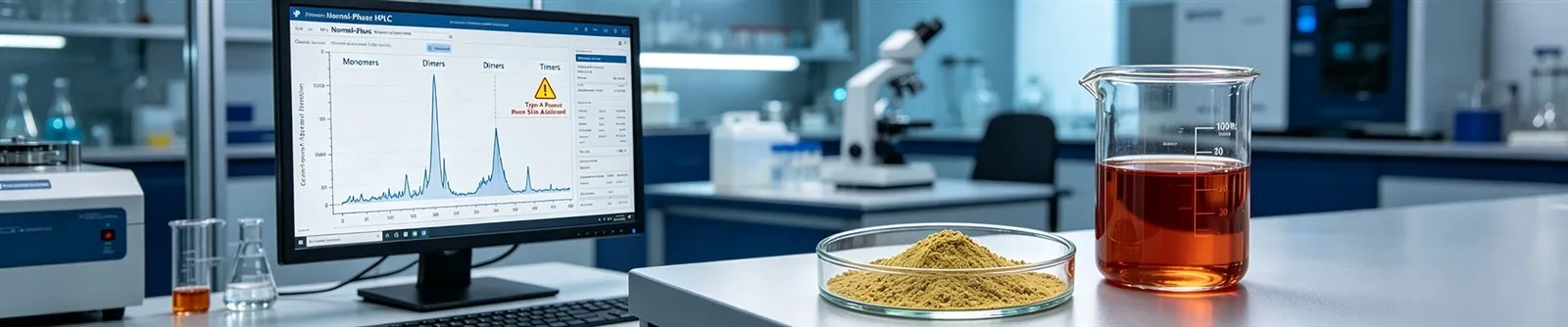
Analytical verification: Normal-phase liquid chromatography fingerprint isolating bioavailable low-DP oligomers from unabsorbable macro-polymers.
Why Does The Degree of Polymerization (DP) Determine True Bioavailability?
Proanthocyanidins are molecular chains. The number of flavan-3-ol units in the chain dictates its **Degree of Polymerization (DP)**.
Human intestinal epithelium can only absorb low-DP fractions. **Oligomers (DP 2 to 4)** possess high solubility and rapid cellular transport kinetics. They easily enter the bloodstream to scavenge free radicals and protect arteries. **Polymers (DP > 5)** are immense, heavy macro-tannins. They are completely insoluble and unabsorbable. They bind to intestinal proteins, causing extreme astringency and gastric distress.
Peanut skin extracts are dominated by heavy, useless polymers with a DP exceeding 10. Cheap suppliers hide these macro-polymers under their total proanthocyanidin assay. Xi'an Tihealth re-engineers the extraction metrics. We deploy advanced **Thiolysis Degradation coupled with LC-MS/MS**. We break the chains to calculate the exact Mean Degree of Polymerization (mDP). We guarantee a low-mDP, oligomer-dominant API matrix tailored for immediate clinical absorption.
Can Normal-Phase HPLC Definitively Isolate Grape Monomers From Peanut Tannins?
Standard reverse-phase chromatography fails to separate complex polyphenols. They elute as a single, messy hump on the chromatogram. This analytical failure allows fraudsters to thrive.
We enforce **Normal-Phase High-Performance Liquid Chromatography (NP-HPLC)**. NP-HPLC segregates proanthocyanidins strictly by their chain length. Monomers elute first, followed cleanly by dimers, trimers, and tetramers.
The data is absolute. Our NP-HPLC fingerprinting ensures that the oligomeric content (DP ≤ 4) represents the vast majority of our extract mass. We strip the useless, high-molecular-weight polymeric dregs. Xi'an Tihealth provides a refined, canary-brown, ultra-soluble micro-powder that dissolves instantly in liquid systems without forming sludgy sediments.
Phytochemical Audit: Grape Seed Extract Sourcing Vectors
| Forensic Metric | Adulterated Peanut Skin Blend | Xi'an Tihealth Standard API |
|---|---|---|
| Interflavan Linkage Type | Type-A Double Links Present | 100% Type-B Single Links Only |
| Mean Degree of Polymerization | Extremely High (mDP > 10 / Insoluble) | Low-mDP (Optimized Oligomers DP 2-4) |
| Assay Validation Method | Porter Assay / UV-Vis Only | NP-HPLC & Thiolysis Degradation |
| Allergen Exposure | High Risk (Residual Peanut Proteins) | Absolute Zero (Hypoallergenic IP) |
| Aqueous Solubility | Poor (Forms floating clumps & tar) | 100% Clear & Dispersible |
Strategic Sourcing FAQ: Bulk Grape Seed OPC
Why does a 95% UV proanthocyanidins certificate fail to prove real quality?Pharmacological Directives & Literature
The degree of polymerization and adulteration vectors analyzed in this technical document are backed by the following scientific research:
- Prior, R. L., et al. (2010). "Proanthocyanidins: Structural characteristics, degree of polymerization, and analytical challenges." Journal of Agricultural and Food Chemistry. URL: https://pubs.acs.org/doi/10.1021/jf903965v
- Appeldoorn, M. M., et al. (2009). "Proanthocyanidin composition of peanut skins: Identification of Type-A dimers and unabsorbable macro-tannins." Food Chemistry. URL: https://pubmed.ncbi.nlm.nih.gov/21211244/
- United States Pharmacopeia (USP): Monograph directives for Grape Seed Dry Extract, specifying normal-phase high-performance liquid chromatography separation vectors for oligomeric evaluation.
Send Inquiry