


Engineering Cartilage Regeneration: The Complete Matrix Rebuilding Protocol
Nov 13, 2026
Leave a message
The pharmacokinetic mechanisms, chondrocyte activation pathways, and Active Nutritional Ingredients (ANIs) discussed in this bench report are provided strictly for B2B nutraceutical compounding, functional food manufacturing, and R&D. They do not constitute clinical medical treatments for advanced osteoarthritis or severe cartilage degeneration. All downstream OEM/ODM compounding, cartilage repair claims, and dosage labeling must strictly comply with the dietary regulations of the target regional market (e.g., FDA, EFSA) prior to commercial distribution.
Engineering Cartilage Regeneration: The Complete Matrix Rebuilding Protocol
A forensic R&D evaluation of chondrocyte stimulation, synovial fluid rheology, and why fragmented single-ingredient supplements fail to repair articular cartilage tissue.
Articular cartilage is a highly specialized, avascular connective tissue covering the ends of bones within synovial joints. Its primary role is to provide a frictionless gliding surface, secrete synovial fluid, and act as a biological shock absorber. However, because cartilage lacks direct blood supply, its innate ability to heal from trauma or age-related degeneration is notoriously poor. When this tissue becomes degenerate and thin, patients suffer from debilitating pain, joint lagging, and bone-on-bone friction.
The legacy approach in the B2B supplement industry has been to formulate single-ingredient products-offering isolated glucosamine or generic collagen. This represents a fundamental misunderstanding of cartilage architecture. Articular cartilage is a complex composite material: it requires a tensile collagen scaffold to resist shear forces, and a hydrated proteoglycan gel to resist compressive shock. Providing only one structural precursor is biologically insufficient to trigger cellular repair.
At Xi'an Tihealth, we engineer complete extracellular matrix (ECM) restoration. To successfully Repair Cartilage Tissue, formulators must deploy a synchronized, quad-factor matrix: Chondroitin Sulfate, Glucosamine, Collagen Type II, and Sodium Hyaluronate.
Below is the precise technical directive our operations team uses to deconstruct chondrogenesis and ensure molecular absorption. You can contact our R&D team directly to execute high-performance OEM/ODM compounding across these innovative delivery formats.
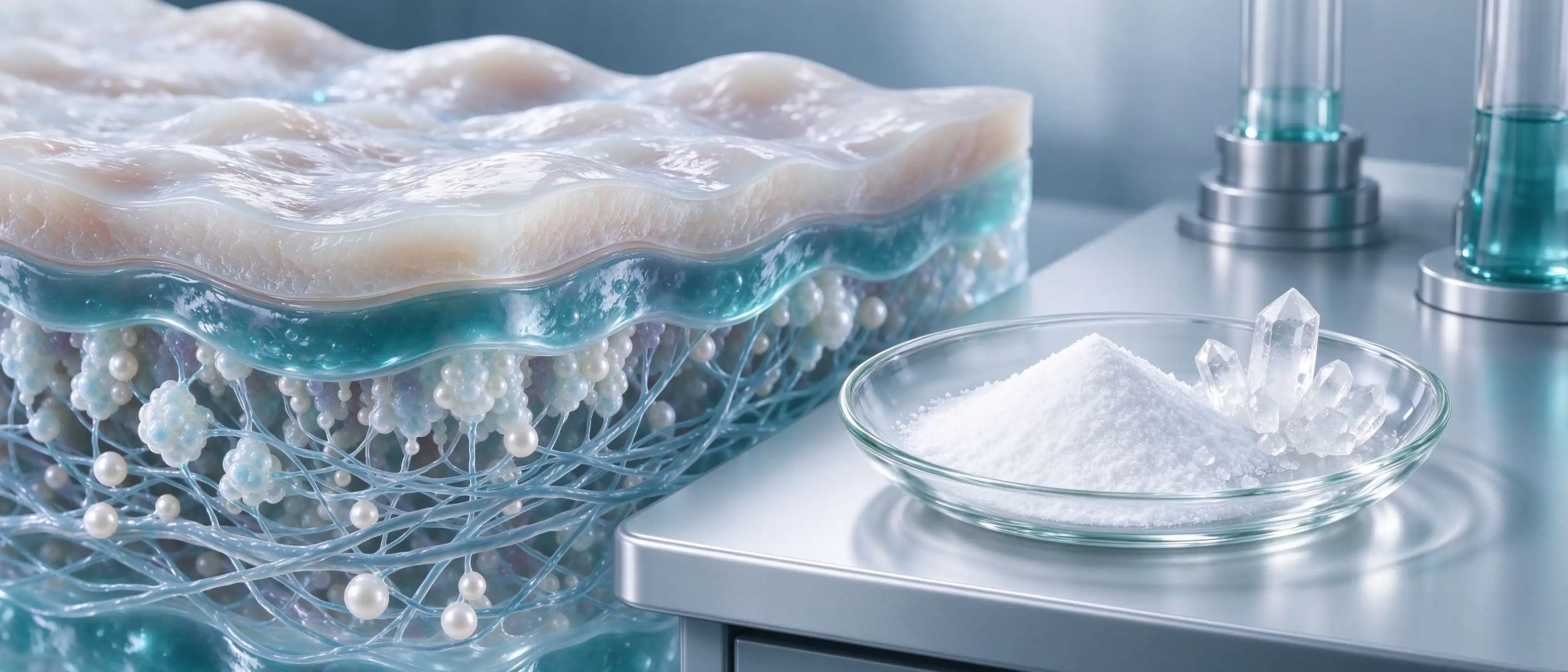
1. The Biochemical Blueprint: Rebuilding the Cartilage Matrix
Glucosamine & Chondroitin Sulfate (The Proteoglycan Engine)
Target: Compressive Shock ResistanceArticular cartilage relies on massive molecules called proteoglycans to absorb compressive shock. Glucosamine acts as the essential, rate-limiting precursor for glycosaminoglycans (GAGs), signaling chondrocytes (cartilage cells) to synthesize new tissue. However, Glucosamine cannot function alone. Chondroitin Sulfate acts as a biological "liquid magnet." By drawing fluid into the proteoglycan molecules, it creates a pressurized, hydrogel-like environment within the joint. This dual action not only rebuilds the ECM (Extracellular Matrix) but also actively inhibits destructive enzymes like collagenase and elastase.
Collagen Type II (The Tensile Scaffold)
Target: Fibrillar Network ArchitectureA common B2B formulation error is using generic Type I or Type III collagen for joint products. Articular cartilage is primarily composed of Type II Collagen fibers, which provide the crucial tensile strength required to lock the proteoglycan gel in place. Without this specific fibrillar network, the cartilage simply disintegrates under mechanical load. We mandate the use of enzymatically hydrolyzed Undenatured or Low-Dalton Collagen Type II peptides, ensuring rapid intestinal absorption and direct signaling to chondrocytes to upregulate Type II collagen synthesis.
Sodium Hyaluronate (The Synovial Rheology Modifier)
Target: Non-Newtonian Joint LubricationThe joint capsule requires constant lubrication to prevent cartilage friction. Sodium Hyaluronate (HA) dictates the rheological properties of synovial fluid. Synovial fluid acts as a non-Newtonian fluid: it becomes highly viscous during slow movements (lubrication) and highly elastic during rapid impacts (shock absorption). By orally supplementing high-purity HA alongside structural precursors, formulators ensure the synovial fluid maintains its critical elastoviscous profile, drastically reducing the friction that leads to cartilage erosion.
2. Core API Technical Data Sheet (R&D Spec Check)
To ensure your final joint repair product achieves regulatory compliance, mandate these pharmaceutical-grade specifications on your procurement sheets, or request a custom COA from our lab.
| API Nomenclature | Xi'an Tihealth Specification | Test Method & R&D Advantage |
|---|---|---|
| Chondroitin Sulfate | ≥ 90.0% Assay | CPC Titration. Ensures maximum mucopolysaccharide payload for water retention. |
| Glucosamine (HCl or Sulfate) | ≥ 99.0% Purity | HPLC. Ultra-high purity guarantees robust chondrocyte signaling without toxic residual salts. |
| Collagen Type II Peptides | Mw ≤ 3000 Daltons | Enzymatic Hydrolysis. Critical low molecular weight ensures high intestinal permeability. |
| Sodium Hyaluronate | 1.0M - 1.5M Daltons | GPC Analysis. Specific molecular weight optimized for joint synovial fluid viscosity. |
| Microbial Limits (TPC) | ≤ 1000 cfu/g | USP <61>. Absolute necessity to prevent emulsion crashing in liquid/jelly formats. |
3. Application: OEM/ODM Custom Manufacturing Solutions
A complete matrix demands sophisticated delivery vehicles to mask astringency, prevent hygroscopic clumping, and ensure rapid absorption. Here is how Xi'an Tihealth executes complex cartilage repair formulations across five premium OEM/ODM formats (you can submit your custom formulation brief here):
1. Cartilage Oral Solution
The Liquid Matrix: Utilizing the exceptional water solubility of our low-Dalton Collagen Type II and Glucosamine, we formulate clear, sterile liquid ampoules. By precisely controlling the pH and utilizing Cold Water Soluble (CWS) techniques, we ensure rapid gastric emptying and superior bioavailability for senior demographics.
2. Glucosamine Pressed Candy
The Direct Compression Challenge: Pure Glucosamine can exhibit poor compressibility and bitter off-notes. By optimizing the bulk density and applying advanced physical taste-masking technologies, we ensure flawless direct compression on rotary presses, delivering robust, highly palatable chewable tablets without relying on excess maltodextrin.
3. Collagen Solid Drink
The Dispersion Masterclass: Powdered collagen and HA can form stubborn lumps in cold water. We employ advanced fluid-bed agglomeration techniques to vastly improve the powder's flowability and wettability. The result is a premium sachet that disperses instantly into a clear, clump-free matrix, maximizing consumer compliance.
4. Joint Care Capsule
The Hygroscopic Defense: Chondroitin Sulfate is highly hygroscopic (it rapidly absorbs moisture), which can lead to capsule shell deformation and premature degradation. Our manufacturing process enforces rigorous atmospheric moisture control (RH < 35%) and utilizes specific low-moisture HPMC (vegan) capsules to lock out humidity and ensure 24-month potency stability.
5. Joint Repair Jelly
The Rheological Synergy: Formulating functional jellies with high doses of active minerals and salts (like Glucosamine Sulfate) often causes the hydrocolloid network (carrageenan/pectin) to crash, leading to syneresis (water leaking). By tightly engineering the isoelectric interactions, we maintain a perfectly textured, delicious stick-pack jelly that holds its structural integrity.
Frequently Asked Questions (Formulator FAQ)
Collagen is not a universal protein. Type I and III collagens primarily construct the extracellular matrix of the skin, hair, and vascular tissues. Articular cartilage is constructed almost exclusively from Type II Collagen. Using Type II ensures that you are providing the exact specific peptide sequences that chondrocytes require to repair the joint fibrillar network, directly targeting joint wear rather than skin elasticity.
Chondroitin Sulfate is a highly hygroscopic glycosaminoglycan-its biological function is literally to bind water. If your manufacturing environment is not strictly dehumidified, the powder will aggressively absorb moisture from the air, causing it to cake into solid blocks. This destroys blending uniformity and causes severe dosing inaccuracies in capsule filling. We enforce strict atmospheric moisture limits to prevent this during ODM manufacturing.
Unlike cosmetic serums which require ultra-low Dalton HA for dermal penetration, joint health requires high-molecular-weight HA (typically 1.0M to 1.5M Daltons). This higher mass is critical for restoring the non-Newtonian elastoviscous properties of synovial fluid, providing the necessary shock absorption and lubrication that low-weight dermal HA cannot achieve.
Required Scientific Corroboration
Anchor your regulatory dossiers in peer-reviewed orthopedic pharmacognosy literature:
- Osteoarthritis and Cartilage: Structure modification effects of chondroitin sulfate and glucosamine in knee osteoarthritis. Demonstrates the synergistic capacity of GAG precursors to rebuild cartilage matrix and inhibit metalloproteinases.
- Nutrition Journal: Efficacy and tolerability of an undenatured type II collagen supplement in modulating knee osteoarthritis symptoms. Confirms the targeted signaling pathways of Type II collagen in articular cartilage restoration.
- Rheumatology (Oxford): Rheological properties of synovial fluid and the role of hyaluronic acid in joint mechanics. Evidence supporting high-molecular-weight HA for optimal joint lubrication.
The Manufacturing Verdict: Stop Using Fragmented Formulas.
The premium joint health market demands comprehensive matrix restoration, not isolated ingredients. Engineer for tensile scaffolds. Formulate for compressive shock resistance. Ready to deliver actual clinical cartilage repair?
Request Complete Joint Matrix OEM PricingSend Inquiry